- Item #
- Y5150
- Compliance
- MUTCD R1-6
Note:
Recommended Accessories
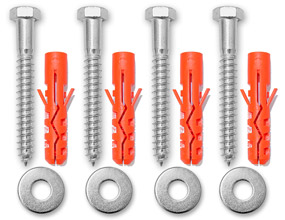
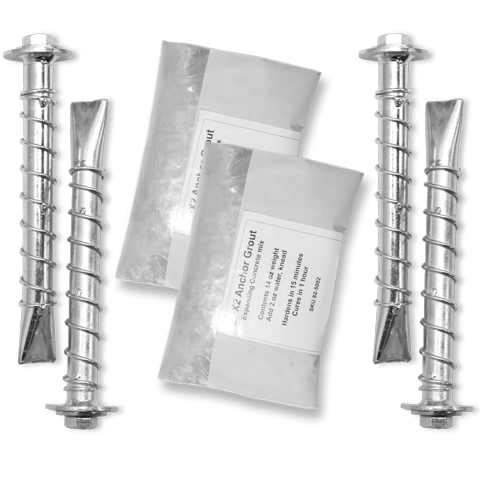
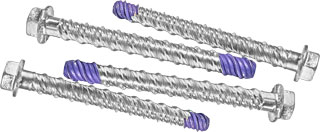
Frequently Purchased Together


Product Information
Details
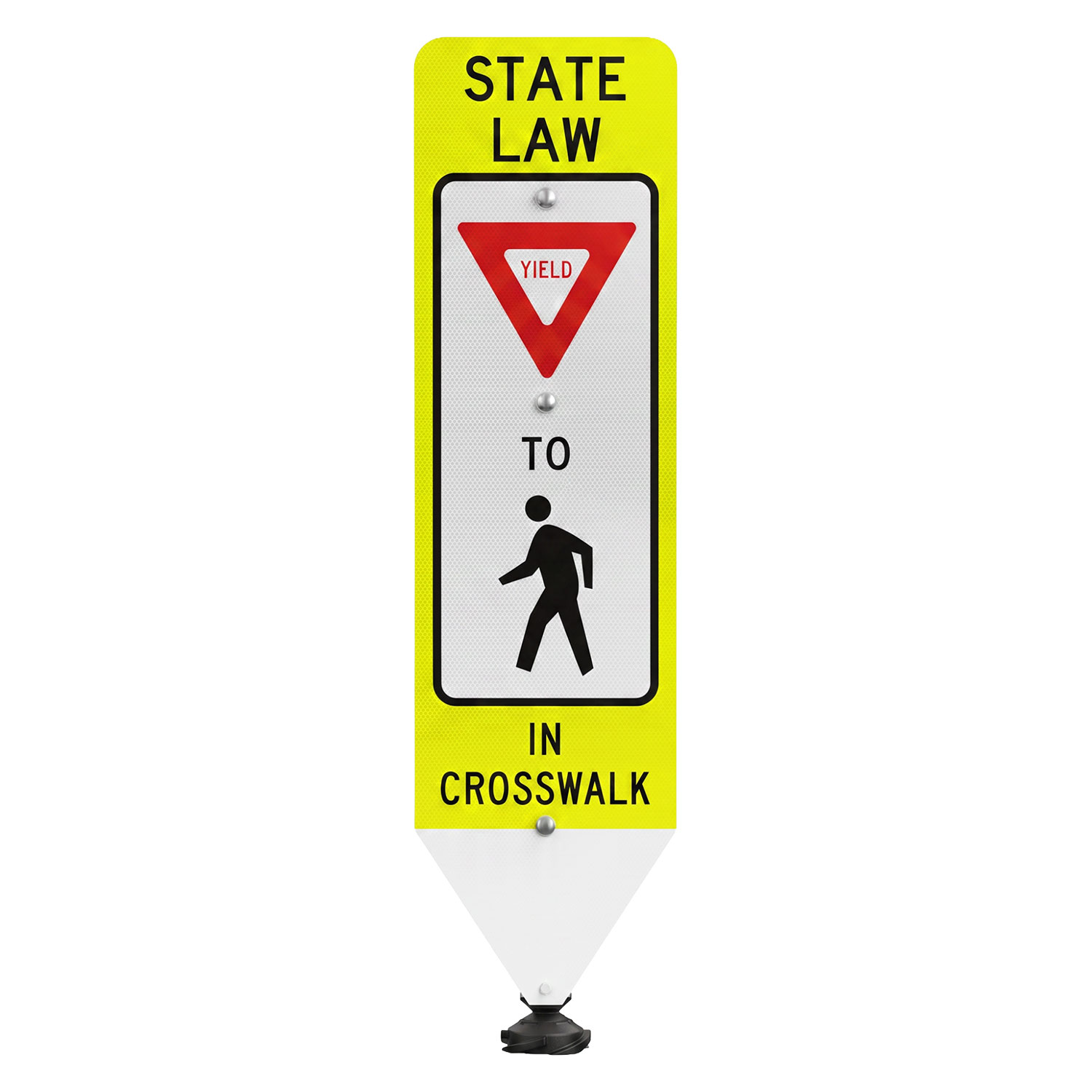
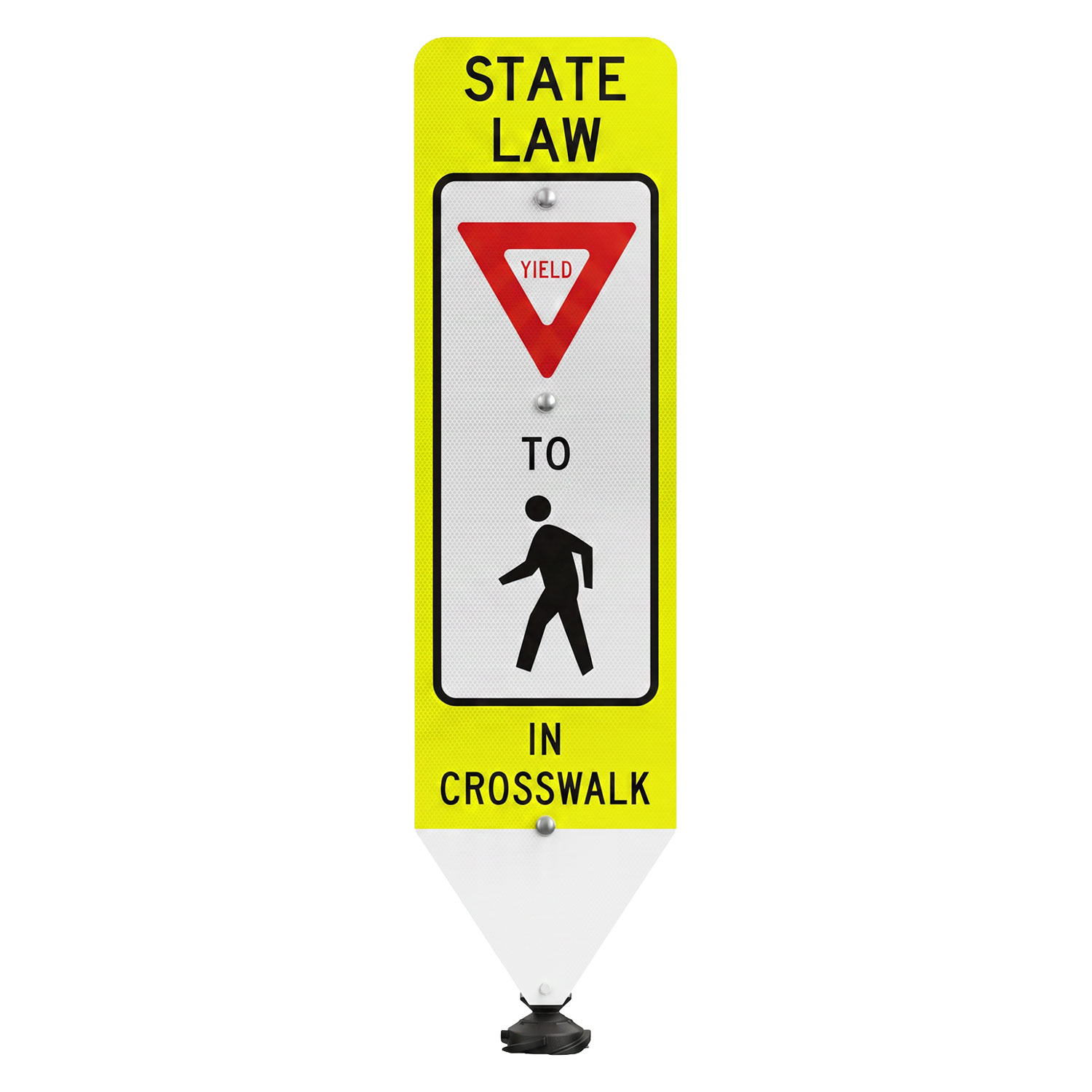
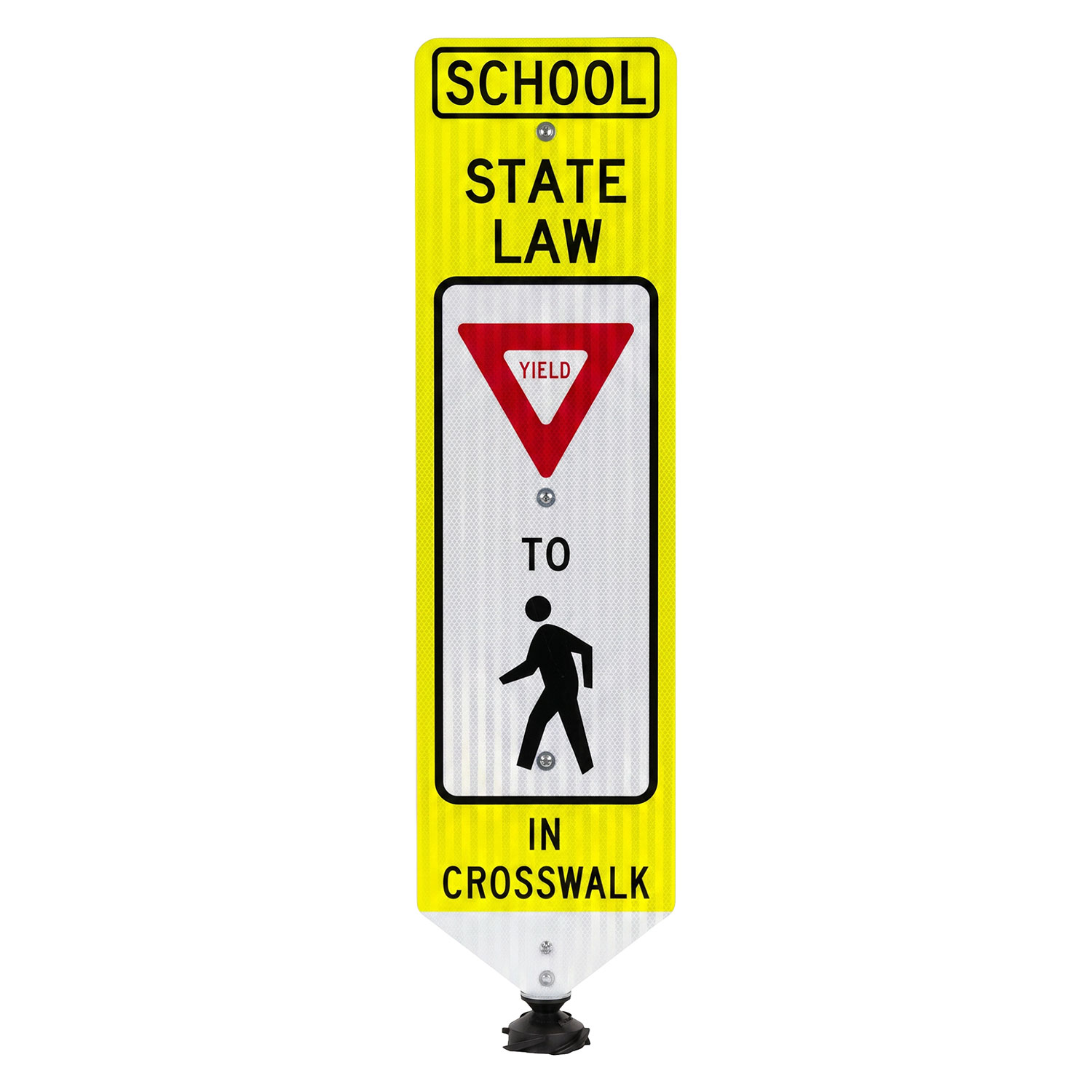
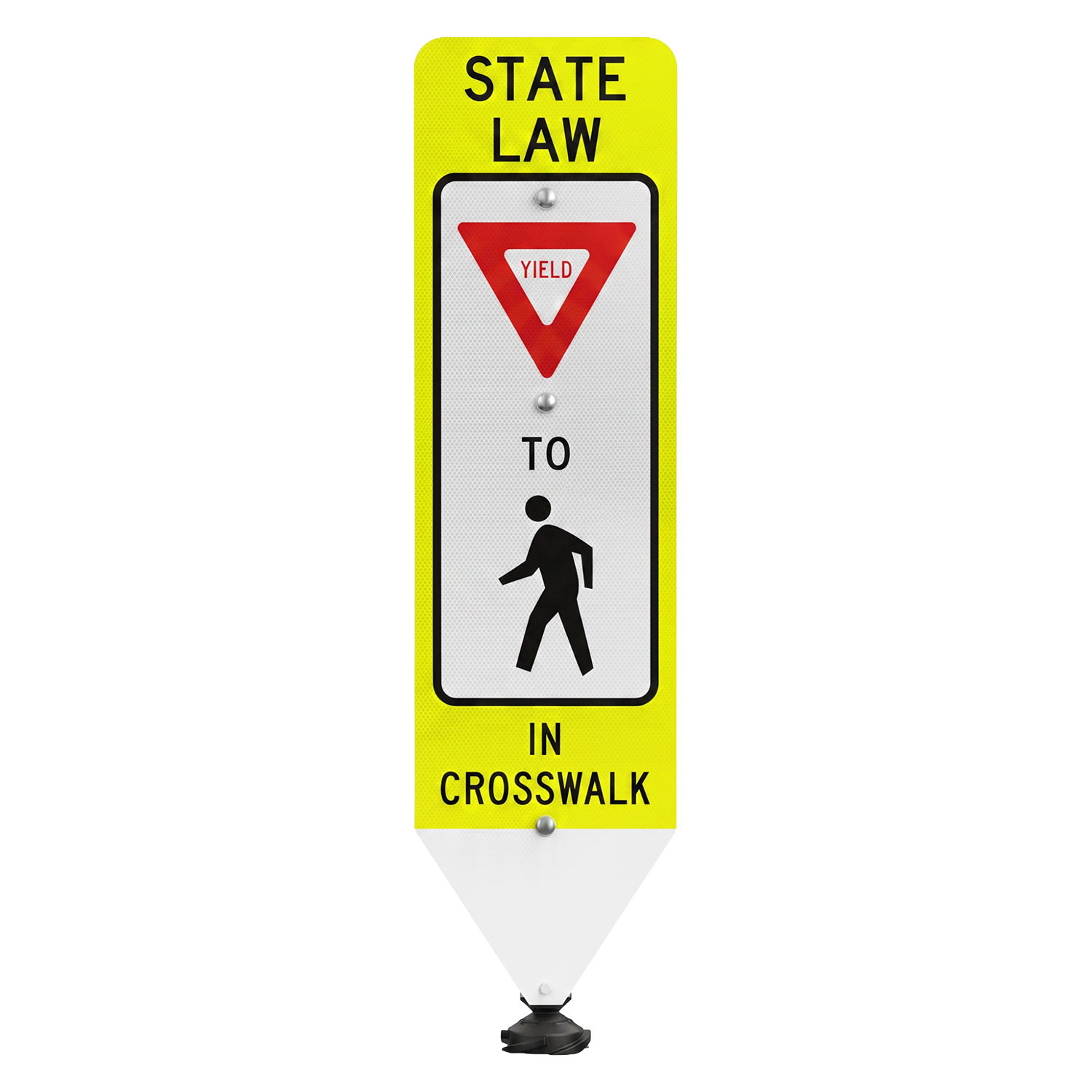
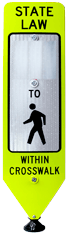
Y5150 — State Law Yield To Pedestrians Panel (R1-6a)
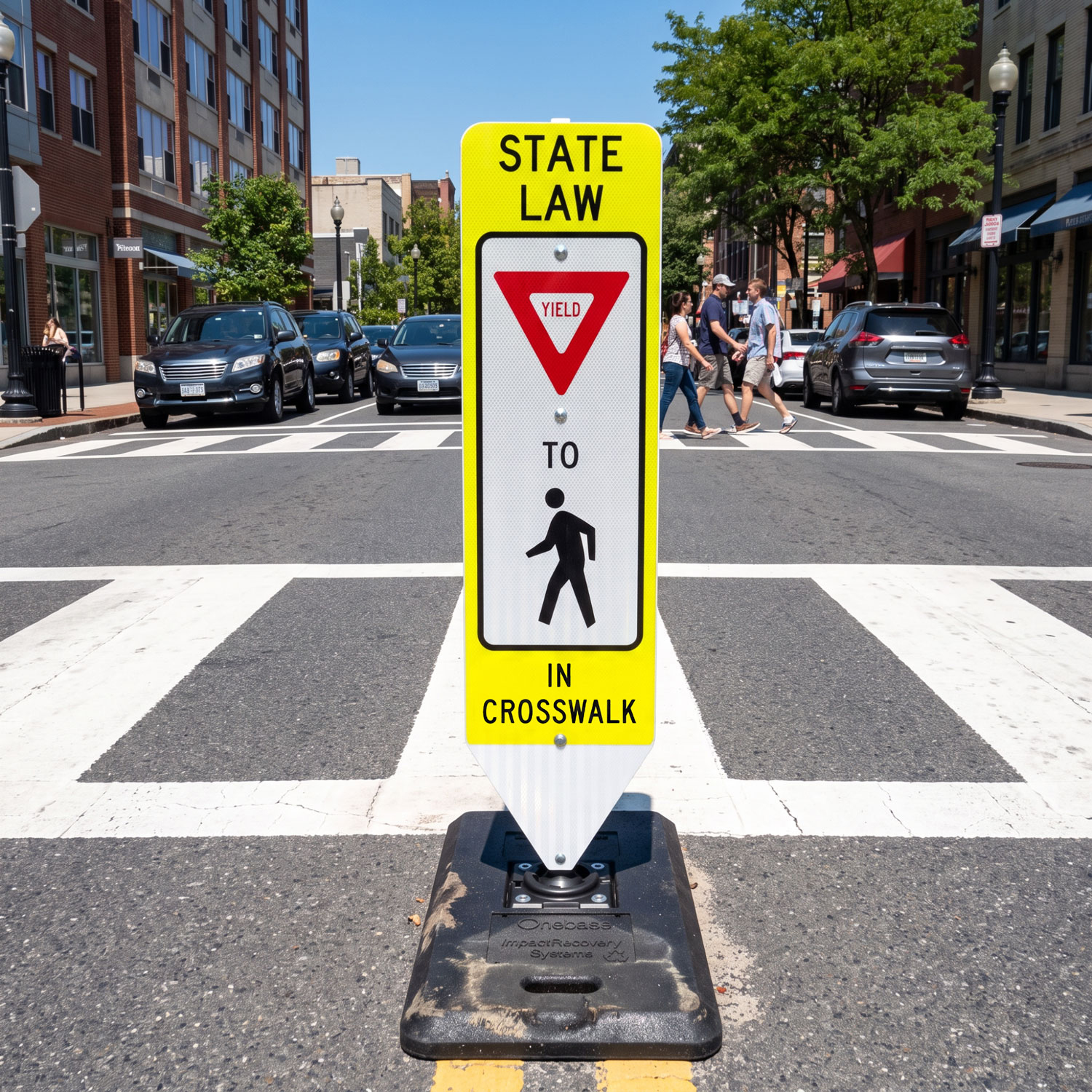
A Replacement Yield To Pedestrians Panel is MUTCD compliant for the safety standards of drivers and pedestrians on roadways and parking areas. A Replacement Yield To Pedestrians Panel is a helpful tool to help enforce traffic regulation and display mandatory information to drivers and pedestrians. This double-sided panel restores an existing in-street crossing assembly to like-new conspicuity without replacing the base. It carries the STATE LAW YIELD TO PEDESTRIANS WITHIN CROSSWALK legend on both faces and drops onto a compatible 36 lb portable or 8″ x 8″ fixed base, so agencies can refresh faded or damaged signs while reusing hardware already in the ground.
Specifications
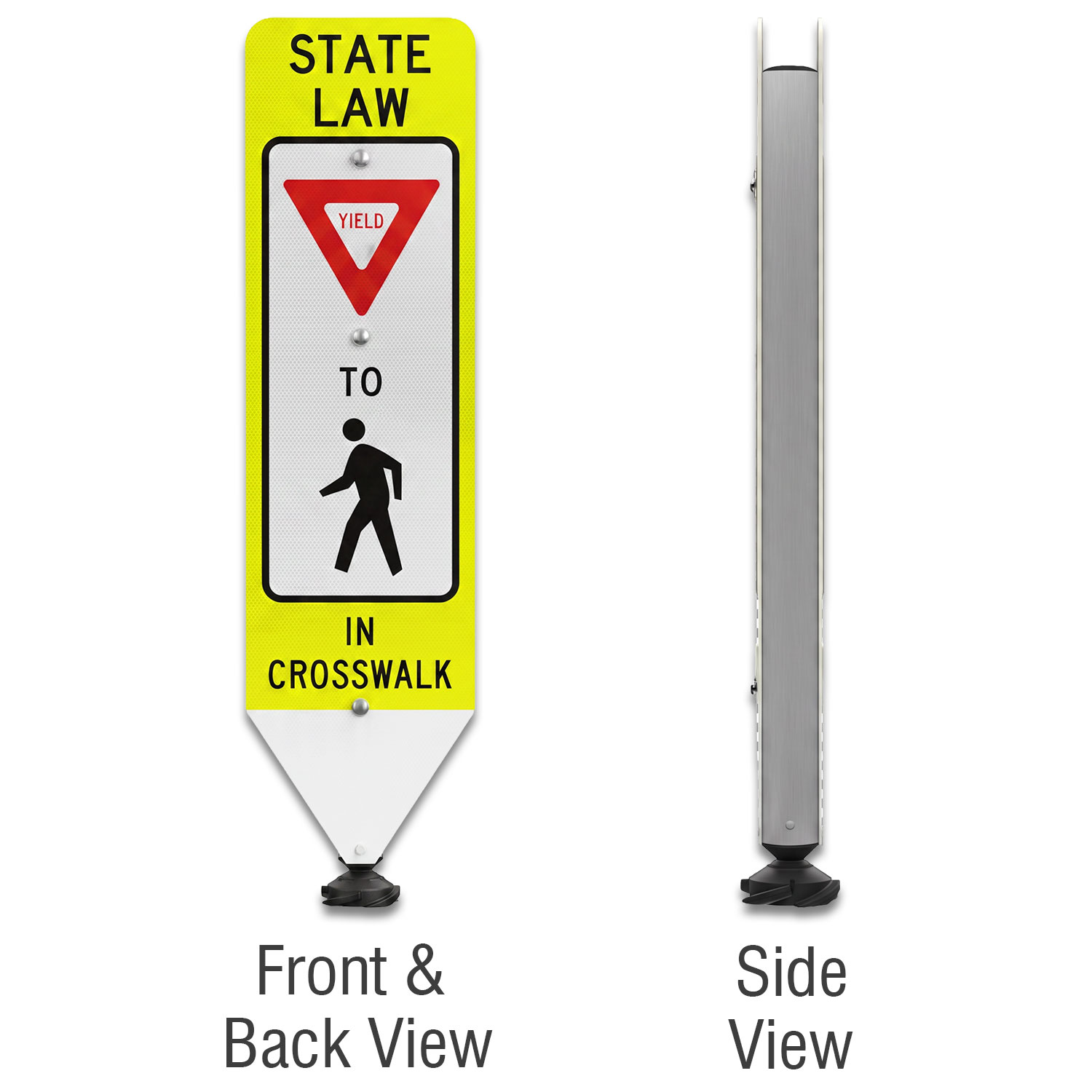
- Panel size: 12″ W x 47″ H, double-sided — the same legend appears on both faces so the sign reads to traffic from either direction.
- Legend: STATE LAW YIELD TO PEDESTRIANS WITHIN CROSSWALK, black legend and border on a white background surrounded by a fluorescent yellow-green field (red STOP or YIELD symbol where used).
- Sheeting: 12″ x 47″ Fluorescent Yellow-Green Diamond Grade reflective sheeting with a 10″ x 24″ White High Intensity reflective insert; the panel face is recessed to protect the sheeting from abrasions and scratches.
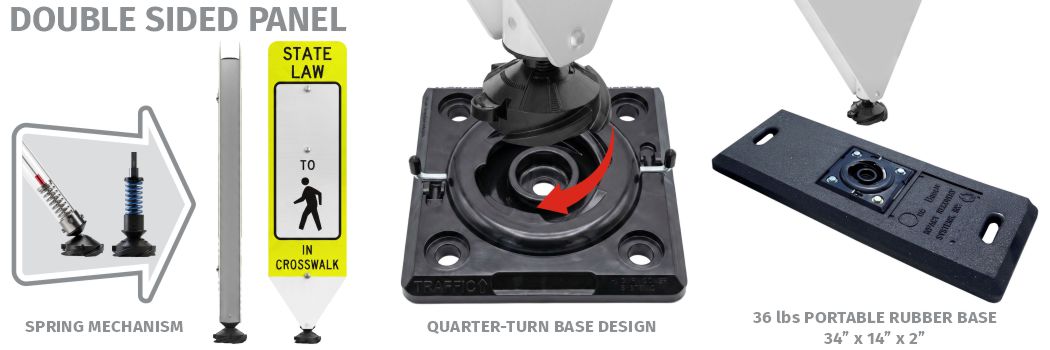
- Construction: durable molded polyethylene panel supported on a high-impact plastic post.
- Impact performance: reactive spring assembly tested at 200 lb tension with a stainless steel cable; the panel bends on vehicle impact and consistently returns to its original vertical position.
- Compliance: meets MUTCD Section 2B.12 In-Street Pedestrian Crossing Signs (R1-6, R1-6a).
- Handling: panel and base separate and stack for easy transport and storage.
- Mounting height: installed, the top of the sign sits within the 4 ft in-street maximum above the pavement surface.
Pedestrian Crossing Panel Assembly
Compliance
MUTCD Section 2B.12, In-Street Pedestrian Crossing Signs
The In-Street Pedestrian Crossing sign (R1-6 or R1-6a) may be used to remind road users of laws regarding right-of-way at an unsignalized pedestrian crosswalk. The legend STATE LAW may be displayed at the top of the sign where applicable, and the legends STOP or YIELD may be used in place of the STOP or YIELD symbol. Highway agencies may develop and apply criteria for determining where these signs are used. Placement (Standard): the sign shall be placed in the roadway at the crosswalk location on the center line, on a lane line, or on a median island, and shall not be post-mounted on the left- or right-hand side of the roadway. It shall not be placed in advance of the crosswalk or used as a stand-alone educational display away from a crosswalk. If an island is available, the sign should be placed on the island (Guidance). Use limits (Standard): the sign shall not be used at signalized locations. The STOP FOR legend shall only be used in states whose law specifically requires a driver to stop for a pedestrian in a crosswalk. Unless placed on a physical island, the sign support shall be designed to bend over and bounce back to its normal vertical position when struck by a vehicle. Mounting height (Standard): the top of an In-Street Pedestrian Crossing sign shall be a maximum of 4 feet above the pavement or island surface; the mounting-height provisions of Section 2A.18 do not apply. The sign may be used seasonally to prevent plow damage in winter and may be removed at night where nighttime pedestrian activity is minimal. In-Street Pedestrian Crossing signs may be used together with Overhead Pedestrian Crossing signs and Yield Here To (Stop Here For) Pedestrians signs at the same crosswalk.
Replacement Pedestrian Crossing Panel Only (For use with Rubber or Fixed Base)
MUTCD 2009 Edition:
Section 2B.12 In-Street and Overhead Pedestrian Crossing Signs (R1-6, R1-6a, R1-9, and R1-9a)
Option:
- The In-Street Pedestrian Crossing (R1-6 or R1-6a) sign or the Overhead Pedestrian Crossing (R1-9 or R1-9a) sign may be used to remind road users of laws regarding right-of-way at an un signalized pedestrian crosswalk. The legend STATE LAW may be displayed at the top of the R1-6, R1-6a, R1-9, and R1-9a signs, if applicable. On the R1-6 and R1-6a signs, the legends STOP or YIELD may be used instead of the appropriate STOP sign or YIELD sign symbol.
- Highway agencies may develop and apply criteria for determining the applicability of In-Street Pedestrian Crossing signs.
- If used, the In-Street Pedestrian Crossing sign shall be placed in the roadway at the crosswalk location on the center line, on a lane line, or on a median island. The In-Street Pedestrian Crossing sign shall not be post-mounted on the left-hand or right-hand side of the roadway.
- If used, the Overhead Pedestrian Crossing sign shall be placed over the roadway at the crosswalk location.
- An In-Street or Overhead Pedestrian Crossing sign shall not be placed in advance of the crosswalk to educate road users about the State law prior to reaching the crosswalk, nor shall it be installed as an educational display that is not near any crosswalk.
- If an island is available, the In-Street Pedestrian Crossing sign, if used, should be placed on the island.
- The In-Street Pedestrian Crossing sign and the Overhead Pedestrian Crossing sign shall not be used at signalized locations.
- The STOP FOR legend shall only be used in States where the State law specifically requires that a driver must stop for a pedestrian in a crosswalk.
- The In-Street Pedestrian Crossing sign shall have a black legend (except for the red STOP or YIELD sign symbols) and border on a white background, surrounded by an outer yellow or fluorescent yellow-green background area. The Overhead Pedestrian Crossing sign shall have a black legend and border on a yellow or fluorescent yellow-green background at the top of the sign and a black legend and border on a white background at the bottom of the sign.
- Unless the In-Street Pedestrian Crossing sign is placed on a physical island, the sign support shall be designed to bend over and then bounce back to its normal vertical position when struck by a vehicle.
- The Provisions of Section 2A.18 concerning mounting height are not applicable for the In-Street Pedestrian Crossing sign.
- The top of an In-Street Pedestrian Crossing sign shall be a maximum of 4 feet above the pavement surface. The top of an In-Street Pedestrian Crossing sign placed in an island shall be a maximum of 4 feet above the island surface.
- The In-Street Pedestrian Crossing sign may be used seasonably to prevent damage in winter because of plowing operations, and may be removed at night if the pedestrian activity at night is minimal.
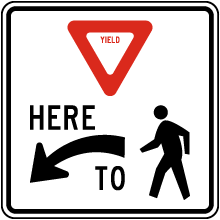
- In-Street Pedestrian Crossing signs, Overhead Pedestrian Crossing signs, and Yield Here To (Stop Here For) Pedestrians signs may be used together at the same crosswalk.
Standard:
Guidance:
Standard:
Support:
Standard:
Technical Resources
Data Sheet